
Choosing the right roof is one of the most important decisions in industrial building construction. Industrial roofing systems must do more than protect a building from rain and sunlight. They need to withstand weather conditions, support insulation requirements, work with the structural system, allow proper drainage, and provide long-term value.
The right roofing solution depends on the building’s purpose, local climate, roof slope, structural design, material performance, maintenance requirements, and budget. A warehouse may have different roofing requirements from a manufacturing plant, cold-storage facility, workshop, or logistics building.
This guide explains the major factors businesses should evaluate before selecting industrial roofing systems, including durability, weather resistance, insulation, cost efficiency, installation, structural compatibility, maintenance, and long-term performance.
Our Services :
United Corporation/PEB Building
Industrial roofing systems are engineered roof assemblies designed for factories, warehouses, manufacturing facilities, workshops, logistics buildings, storage facilities, and other large commercial or industrial structures.
Depending on the building and project requirements, an industrial roof may include:
The complete roof assembly should be considered rather than selecting roofing sheets alone.
The roof is continuously exposed to environmental conditions. Poor material selection or inadequate installation can lead to water leakage, corrosion, heat gain, insulation problems, and premature maintenance.
A suitable roofing system can help provide:
The objective should be to select a system that matches the building’s actual operating conditions rather than simply choosing the lowest initial-cost option.
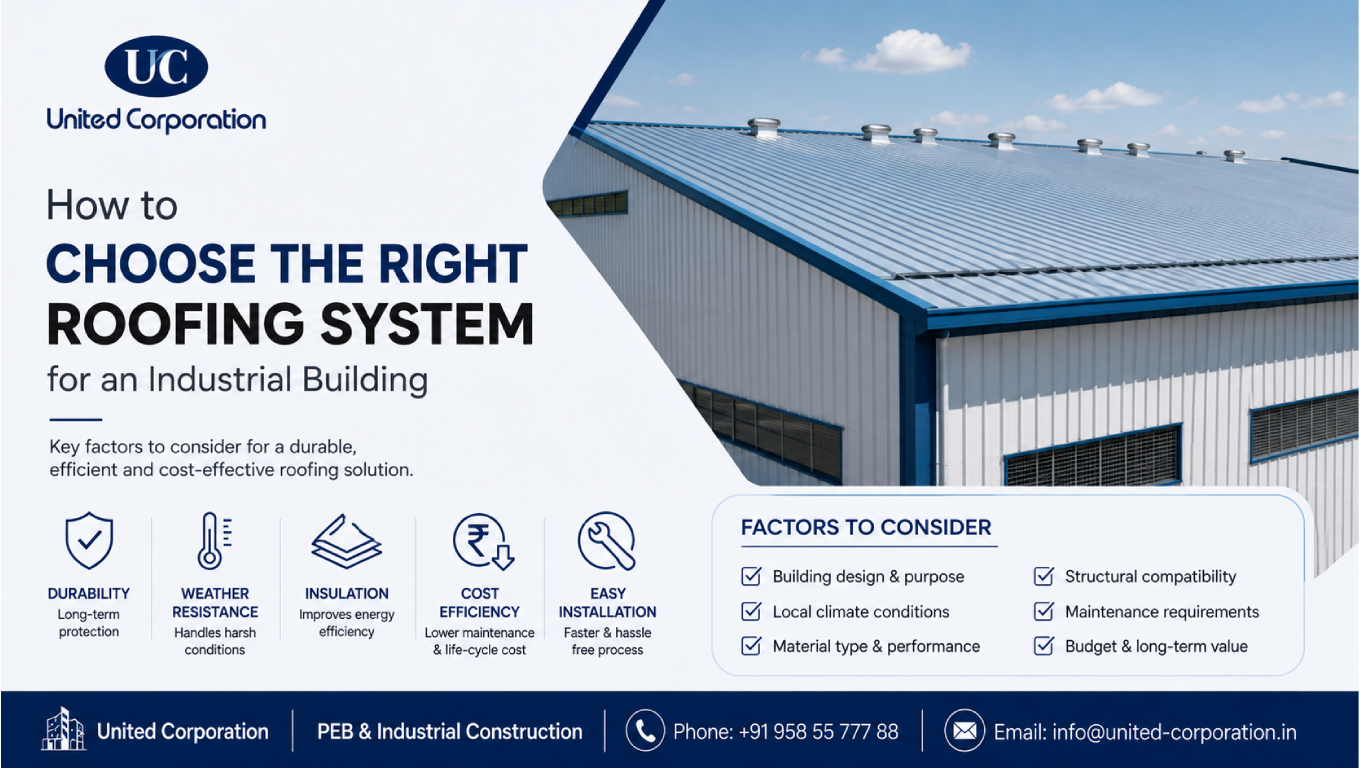
Your image highlights eight important factors that should be considered before choosing an industrial roofing solution.
The first consideration is how the building will be used.
A warehouse storing general goods may require a different roof from a manufacturing facility with heat-generating machinery.
Consider:
Understanding the building’s purpose helps determine the appropriate roofing material, insulation, ventilation, and drainage requirements.
Climate has a major influence on roof selection.
Consider the area’s:
For example, a building exposed to intense sunlight may benefit from a reflective roof surface and suitable insulation. In high-rainfall areas, roof slope, drainage capacity, gutters, and detailing become particularly important.
The U.S. Department of Energy notes that roof design and materials can influence cooling requirements, particularly when reflective surfaces reduce solar heat absorption.
Different roofing materials offer different performance characteristics.
Common industrial options include:
The material should be evaluated based on strength, corrosion resistance, thermal performance, installation method, expected service environment, and maintenance requirements.
For industrial buildings, the roof should also be compatible with the supporting structural system.
A roofing system must work properly with the building’s structural frame.
For steel and PEB structures, roof components commonly interact with:
The roof should be designed for applicable dead loads, environmental loads, maintenance loads, and other project-specific requirements.
Roof penetrations for equipment, ventilation, skylights, ducts, and other services should also be coordinated during design.
Every roof requires some level of inspection and maintenance.
Before selecting a system, consider:
A roofing system that is inexpensive initially may become expensive if it requires frequent repairs or difficult maintenance.
A lifecycle-cost approach can provide a better basis for comparison.
Initial price is important, but it should not be the only deciding factor.
Compare:
Initial cost + installation + maintenance + energy performance + expected service life + replacement requirements
A slightly higher initial investment may provide better long-term value if the roof offers improved durability, insulation, or maintenance performance.
The correct solution depends on the specific project rather than a universal “cheapest roof” option.
Installation quality has a major effect on roof performance.
The installation process may involve:
Incorrect installation can create leakage and durability problems even when high-quality materials are used.
Roof installation should therefore be carried out according to the approved design, manufacturer requirements, and applicable safety procedures.
Industrial buildings may require regular access for:
Access provisions should be considered during the design stage.
Roof work also presents fall hazards. OSHA’s roofing guidance emphasizes the need for appropriate fall-protection measures during roofing activities.
For projects outside the United States, the applicable local occupational-safety requirements should be followed.
The image also highlights five important benefits of selecting a suitable industrial roofing solution.
A durable roof can provide long-term protection against weather and operational conditions.
Material quality, coating, installation, drainage, and maintenance all influence durability.
A roofing system should be selected according to the environment in which it will operate.
Industrial roofs need to withstand rain, wind, sunlight, temperature changes, and other environmental conditions.
Good roof detailing is just as important as the roofing material itself.
Critical areas include:
These areas should be carefully designed and installed to reduce the risk of water infiltration.
Insulation can significantly influence indoor thermal conditions.
A properly designed roof assembly can reduce unwanted heat transfer between the exterior and interior.
The U.S. Department of Energy specifically notes that thermal insulation reduces heat gain and heat loss through roofs and should not be treated as interchangeable with a reflective roof surface.
Depending on the building, insulation options may include:
The appropriate material depends on thermal requirements, fire performance, moisture conditions, and project specifications.
A cost-efficient roofing system balances initial investment with long-term performance.
Businesses should evaluate:
This approach provides a better understanding of the actual value of the roof over its operating life.
Many modern industrial roofing systems are designed for efficient installation.
Factory-produced panels and coordinated components can help simplify site installation.
However, installation speed should never compromise:
A faster installation is beneficial only when the completed roof performs as intended.
Different projects may require different roofing approaches.
Metal roofing is widely used for industrial buildings because of its strength, relatively low weight, and suitability for large roof areas.
Steel roofing can be supplied with protective coatings and factory-applied finishes.
Standing-seam systems use raised seams between panels and can provide a clean roof profile with concealed or specially designed fastening systems depending on the product.
They may be suitable for projects where long roof runs and reduced exposed fasteners are desirable.
Sandwich panels combine outer metal skins with an insulating core.
They can provide both weather protection and thermal insulation within one panel assembly.
They are often considered for industrial facilities where thermal performance is important.
Membrane systems may be considered for suitable low-slope applications.
The correct membrane depends on:
The roofing designer should select the membrane system according to the project’s technical requirements.
Industrial buildings can experience significant solar heat gain through the roof, particularly in hot climates.
A properly designed insulated roof can help:
However, insulation thickness should not be selected simply by choosing the thickest available material.
The design should consider the required thermal performance, moisture control, fire performance, roof assembly, and local climate.
Ventilation can be an important component of industrial roof design.
Possible solutions include:
The appropriate approach depends on the building’s heat generation, occupancy, processes, climate, and indoor air requirements.
A well-designed roof assembly should also consider moisture movement and condensation control. Building-science guidance from the U.S. Department of Energy highlights the importance of air and moisture control within high-performance roof assemblies.
Effective drainage is essential for protecting an industrial building from water-related problems.
The roof design should consider:
Blocked or undersized drainage systems can cause water accumulation and increase the risk of leakage.
Regular inspection and cleaning should therefore be part of the building maintenance plan.
Cool roofing can be useful in suitable climates.
A cool roof generally uses a surface with higher solar reflectance and appropriate thermal-emittance characteristics to reduce solar heat absorption.
The U.S. Department of Energy notes that cool roofs can reduce cooling demand in warm climates, while also emphasizing that climate and building characteristics should be considered before selection.
Therefore, a reflective roof should not automatically be considered the best option for every building.
PEB structures frequently use metal roof systems because the roofing components can be coordinated with the steel framing and purlins.
Important coordination areas include:
Proper coordination between structural drawings and roofing details can reduce installation problems.
Internal Link Opportunity: Link PEB structural design services to your relevant service page.
Use this practical checklist before finalizing your roof:
This approach helps businesses evaluate the complete roof system rather than focusing only on the roofing sheet price.
The cheapest roofing material may not provide the best long-term value.
In hot or temperature-sensitive facilities, inadequate insulation can increase indoor heat gain.
Insufficient drainage can increase the risk of water accumulation and leakage.
Unplanned openings for equipment can create difficult detailing and waterproofing challenges.
Different metals and coatings can behave differently in corrosive environments. Compatibility should be evaluated during design.
Even durable roofs require periodic inspection and maintenance.
Incorrect fastening, flashing, sealing, or panel alignment can reduce the expected performance of the roof.
A maintenance program should include regular inspection of:
Debris should be removed from drainage areas where necessary.
Early detection of corrosion, loose components, damaged panels, or failed sealants can help prevent more expensive repairs.
Selecting the right industrial roofing systems requires more than comparing roofing materials and prices.
The ideal system should match the building’s purpose, climate, structural design, thermal requirements, drainage needs, maintenance strategy, installation requirements, and long-term budget.
Durability, weather resistance, insulation, cost efficiency, and installation are important performance considerations. At the same time, businesses should evaluate structural compatibility, local climate, material performance, maintenance requirements, and long-term value before making a final decision.
For PEB and industrial buildings, early coordination between structural engineers, architects, roofing specialists, and contractors can help ensure that the roof works effectively as part of the complete building envelope.
The right industrial roof is not necessarily the cheapest option—it is the system that delivers the right combination of performance, durability, safety, maintenance, and lifecycle value for the building.
Industrial roofing systems are complete roof assemblies designed for factories, warehouses, manufacturing facilities, workshops, logistics buildings, and other large structures. They may include metal sheets, insulation, purlins, fasteners, flashings, gutters, ventilation, and other components.
There is no single best system for every industrial building. The appropriate option depends on the building’s purpose, climate, roof slope, structural system, insulation requirements, corrosion exposure, maintenance needs, and budget.
Yes. Metal roofing is widely used for industrial buildings because it can provide durability, relatively low structural weight, and suitability for large roof areas. The correct metal type, coating, thickness, fastening system, and installation method should be selected according to project requirements.
Roof insulation helps reduce heat transfer between the exterior and interior of the building. It can improve indoor thermal conditions and, depending on the building and climate, help reduce heating or cooling requirements.
Service life varies significantly according to the roofing material, coating, climate, installation quality, exposure, maintenance, and design. A specific lifespan should therefore be based on the selected product and project conditions rather than a universal number.
Lorem ipsum dolor sit amet, consectetur adipiscing elit. Ut elit tellus, luctus nec ullamcorper mattis, pulvinar dapibus leo.
Lorem ipsum dolor sit amet, consectetur adipiscing elit. Ut elit tellus, luctus nec ullamcorper mattis, pulvinar dapibus leo.
Whether you have a project in mind and you’re looking for a reliable construction partner or you’re looking to take the next step in your career, we want to hear from you!
