
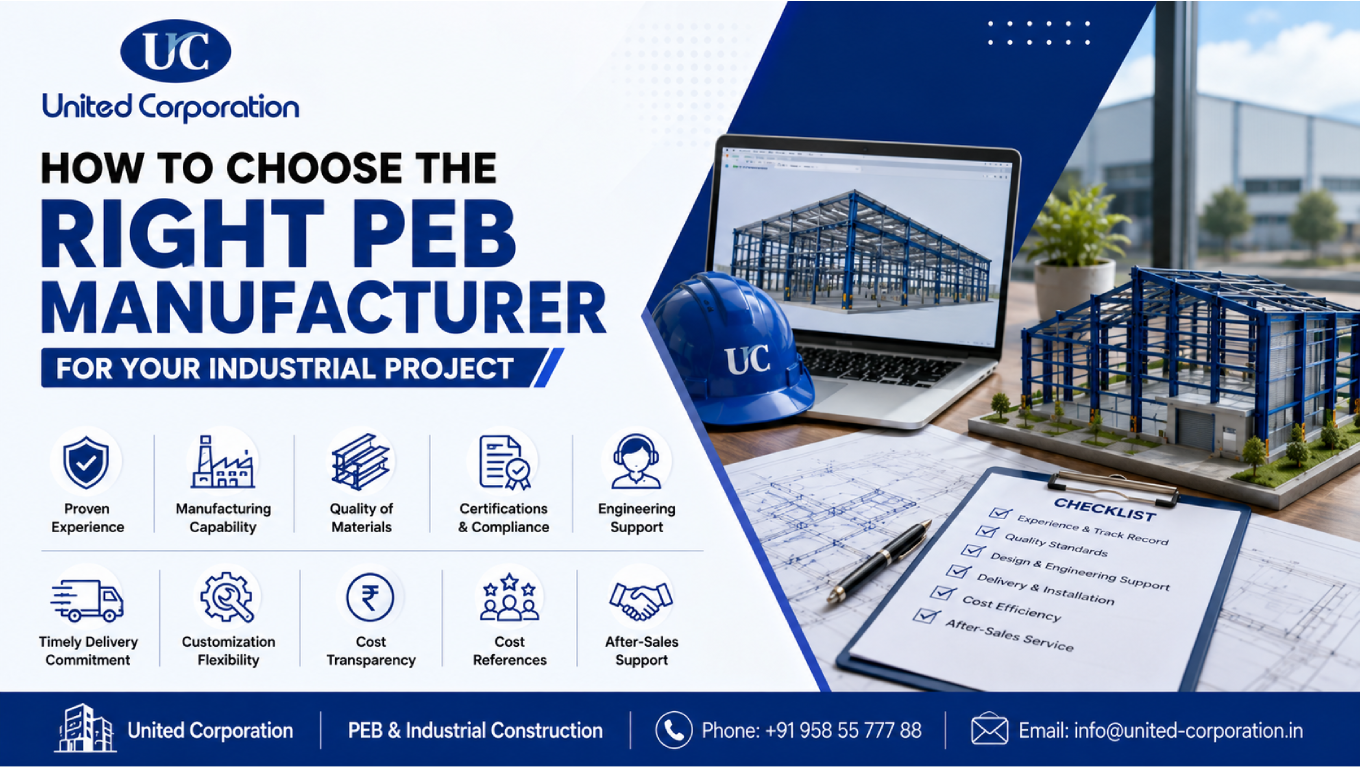
Choosing the right PEB manufacturer is one of the most important decisions when planning an industrial building. The manufacturer you select can directly influence structural quality, project cost, construction timelines, customization, installation, and long-term building performance.
A Pre-Engineered Building (PEB) is more than a collection of steel components. It is an engineered building system that requires proper design, fabrication, quality control, transportation, and erection. Therefore, selecting a manufacturer based only on the lowest quotation can create problems later.
A reliable PEB manufacturer should have suitable manufacturing capabilities, experienced engineering professionals, quality-control processes, appropriate certifications, transparent pricing, reliable delivery, and strong after-sales support.
This guide explains the most important factors businesses should consider when choosing a PEB manufacturer for factories, warehouses, workshops, logistics facilities, and other industrial projects.
Our Services:
United Corporation/PEB Building
The right PEB manufacturer can make the construction process more organized and predictable.
A manufacturer may be involved in several stages, including:
If any of these stages are poorly managed, the project may experience delays, additional costs, fabrication errors, or installation difficulties.
A good manufacturer should therefore be evaluated based on the complete project lifecycle, not simply the initial quotation.
Experience is one of the first things to evaluate when selecting a PEB manufacturer.
Look for a company that has successfully completed projects similar to yours.
Ask about experience with:
A manufacturer with relevant experience is more likely to understand the practical challenges associated with your type of project.
Before making a decision, ask for:
The goal is not simply to find the oldest company. The goal is to find a PEB manufacturer with relevant and demonstrable experience.
A manufacturer’s production capability directly affects its ability to handle your project.
Evaluate the company’s:
A manufacturer should have sufficient capacity to complete your project without compromising quality or delivery schedules.
For larger industrial projects, manufacturing capacity becomes particularly important because the project may involve a substantial quantity of structural steel and secondary components.
The quality of raw materials has a direct effect on the final building.
A professional PEB manufacturer should be able to provide information about the materials used for:
Ask whether material certificates and quality documentation are available where required.
Material selection should be based on the project’s structural requirements, environmental conditions, applicable standards, and engineering specifications.
For structural steel resources and standards, American Institute of Steel Construction (AISC) is a useful technical reference.
Certifications and compliance procedures can provide useful information about a manufacturer’s quality-management practices.
Ask the PEB manufacturer about relevant:
Certifications should not be viewed as the only measure of quality. They should be considered alongside actual project experience, engineering capability, manufacturing processes, and quality-control procedures.
For general workplace and construction safety information, OSHA – Construction Safety and Health provides useful resources.
A capable PEB manufacturer should have access to experienced engineering and detailing professionals.
Engineering support may include:
The manufacturer should understand project-specific requirements such as:
Good engineering support can reduce errors before fabrication begins.
Construction delays can affect business operations and project finances.
A reliable PEB manufacturer should provide a realistic production and delivery schedule.
Ask about:
The manufacturer should also explain how schedule changes will be communicated.
Avoid selecting a supplier based solely on an extremely short delivery promise. A realistic schedule is more valuable than an unrealistic commitment.
Every industrial project has different requirements.
A good PEB manufacturer should be capable of adapting the building to project-specific needs.
Customization may involve:
A manufacturer should understand your operational requirements before finalizing the structural design.
Price is important, but the cheapest quotation is not always the best option.
When comparing PEB manufacturers, request a detailed quotation showing what is included.
The quotation may cover:
Ask about exclusions as well.
A low initial quotation may become expensive if important components are excluded and need to be purchased separately.
Cost transparency helps you make a more accurate comparison between manufacturers.
A strong project portfolio can demonstrate a manufacturer’s practical experience.
When reviewing previous projects, look for buildings similar to your proposed facility.
For example, if you are planning a warehouse, review the manufacturer’s warehouse projects.
If you need a factory with overhead cranes, ask about previous crane-supported industrial buildings.
Useful questions include:
Real project experience can provide valuable insight beyond marketing material.
The relationship with a PEB manufacturer should not necessarily end when the building is erected.
After-sales support may include:
Strong after-sales service can be particularly useful when the building requires modifications several years after construction.
It is important to understand the difference between a manufacturer and a contractor.
A PEB manufacturer typically focuses on engineering, fabrication, and supply of the pre-engineered building system.
A contractor may be responsible for:
Some companies provide both manufacturing and construction services.
Before signing a contract, clearly identify who is responsible for each part of the project.
Before selecting a manufacturer, prepare a list of questions.
Do not compare manufacturers only by price.
Create a comparison based on:
| Factor | Manufacturer A | Manufacturer B | Manufacturer C |
|---|---|---|---|
| Experience | ✓ | ✓ | ✓ |
| Manufacturing capacity | ✓ | ✓ | ✓ |
| Engineering support | ✓ | ✓ | ✓ |
| Material quality | ✓ | ✓ | ✓ |
| Certifications | ✓ | ✓ | ✓ |
| Delivery commitment | ✓ | ✓ | ✓ |
| Customization | ✓ | ✓ | ✓ |
| Cost transparency | ✓ | ✓ | ✓ |
| Project references | ✓ | ✓ | ✓ |
| After-sales support | ✓ | ✓ | ✓ |
This approach helps you evaluate the overall value rather than selecting a manufacturer simply because it submitted the lowest price.
Not every manufacturer offers the same level of service.
Be cautious if a company:
These factors do not automatically mean a company is unsuitable, but they should encourage you to investigate further.
Accurate detailing is an essential part of PEB manufacturing.
PEB detailing converts engineering requirements into fabrication and erection information.
It can include:
Accurate detailing helps reduce fabrication errors and site modifications.
This is why businesses should evaluate the manufacturer’s detailing capabilities before placing an order.
Quality control should take place throughout the manufacturing process.
Important stages can include:
A documented quality-control process can help maintain consistency across fabricated components.
Selecting the right manufacturer can influence several parts of the project budget.
An experienced manufacturer may help reduce:
However, project cost also depends on engineering design, building dimensions, material specifications, site conditions, transportation, erection, foundation design, and finishing requirements.
Therefore, always evaluate total project cost, not just the steel price.
If your business expects to grow, tell the manufacturer before the design is finalized.
Future requirements may include:
Early planning can allow the structural design to consider potential expansion.
This can be much easier than trying to modify an existing building without considering future requirements.
BIM can improve coordination between structural and other building disciplines.
A coordinated model can help visualize:
Clash detection can identify potential conflicts before fabrication or installation.
For larger and more complex industrial projects, BIM coordination can therefore improve project planning and reduce rework.
Manufacturing the steel structure is only one part of a successful PEB project.
The components must reach the site in the correct sequence and be erected correctly.
Ask the PEB manufacturer about:
Good coordination between manufacturing and erection teams can help reduce installation problems.
Before making your final decision, verify:
Choosing a PEB manufacturer should be treated as a long-term project decision rather than a simple purchasing decision.
Start by clearly defining your building requirements. Then compare manufacturers based on experience, engineering, manufacturing capacity, material quality, delivery, cost transparency, customization, and after-sales support.
Request detailed quotations from multiple manufacturers and make sure each quotation covers the same scope. This makes price comparisons much more meaningful.
Most importantly, do not compromise engineering and quality simply to reduce the initial project cost.
A manufacturer that provides good engineering, accurate fabrication, dependable delivery, and responsive technical support can contribute significantly to the success of an industrial construction project.
Choosing the right PEB manufacturer is essential for developing a safe, efficient, durable, and cost-effective industrial building.
The best manufacturer should offer more than steel fabrication. You should look for a combination of proven experience, manufacturing capability, quality materials, engineering support, certifications, timely delivery, customization, transparent pricing, project references, and after-sales service.
Whether you are planning a warehouse, factory, workshop, logistics facility, or manufacturing plant, carefully evaluating your PEB manufacturer can help reduce construction risks and improve long-term project performance.
Before making the final decision, compare multiple manufacturers, verify their previous projects, review technical specifications, understand the complete scope of work, and evaluate the total project value.
The right PEB manufacturer can become an important partner in turning your industrial building plan into a reliable and future-ready facility.
Evaluate the manufacturer’s experience, manufacturing capacity, material quality, engineering support, certifications, delivery record, customization capability, pricing transparency, project references, installation support, and after-sales service.
Ask about previous projects, manufacturing facilities, engineering capabilities, materials, quality-control procedures, delivery timelines, installation support, warranty terms, and after-sales service.
Not necessarily. The lowest quotation may exclude important components or services. Compare the complete scope, material specifications, engineering, fabrication, transportation, erection, warranty, and after-sales support before making a decision.
Ask about relevant quality-management, welding, material, manufacturing, and applicable building-code compliance documentation. The specific requirements depend on the project location, design, and applicable standards.
Engineering support ensures that the building is designed according to project-specific requirements such as dimensions, structural loads, wind, seismic conditions, cranes, equipment, openings, and future expansion.
Whether you have a project in mind and you’re looking for a reliable construction partner or you’re looking to take the next step in your career, we want to hear from you!
