
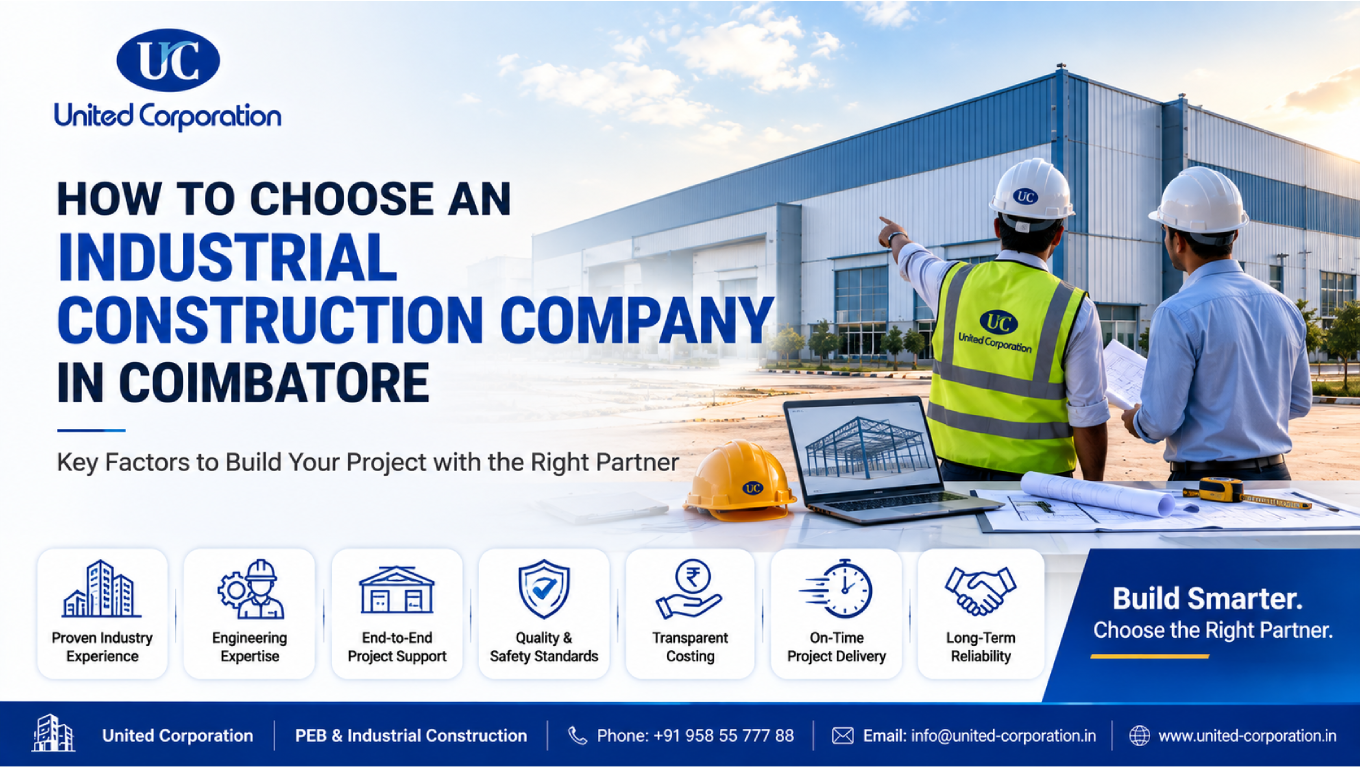
Choosing the right industrial construction company in Coimbatore is an important decision for businesses planning a factory, warehouse, manufacturing facility, industrial shed, or other commercial-industrial project. The right construction partner can influence the project’s quality, timeline, budget, safety, and long-term performance.
Industrial construction is more complex than constructing a basic commercial building. It may involve structural steel, PEB systems, foundations, roofing and cladding, industrial flooring, electrical systems, fire protection, ventilation, machinery foundations, MEP services, and detailed project coordination.
Coimbatore has a strong industrial and manufacturing ecosystem, making it an active market for factories, warehouses, engineering facilities, textile units, automobile-related businesses, and other industrial developments. Before selecting a contractor or construction partner, businesses should carefully evaluate experience, technical capabilities, project management, safety practices, estimating capabilities, and communication.
This guide explains the key factors to consider when choosing an industrial construction company in Coimbatore and how businesses can make a more informed decision.
Our Services :
United Corporation/PEB Building
An industrial building is a long-term investment. Construction decisions can affect the facility for many years after completion.
The right company can help with:
Choosing a company based only on the lowest quotation can create risks if the contractor does not have the technical experience or resources required for the project.
An industrial construction company may provide some or all of the services required to plan and construct an industrial facility.
Depending on the company and project scope, services may include:
Before signing a contract, clearly identify which services are included and which will be handled by other consultants or contractors.
Experience is one of the first factors to evaluate.
Look for a company that has worked on projects similar to yours, such as:
A company experienced in residential construction may not necessarily have the expertise needed for a complex industrial project.
Ask potential contractors for examples of completed projects with similar:
A portfolio can provide useful information about a company’s capabilities.
When reviewing previous projects, look at:
If possible, visit completed projects or speak with previous clients.
This can provide a better understanding of the contractor’s actual performance than marketing materials alone.
An experienced industrial construction company in Coimbatore should understand the technical requirements of industrial facilities.
Depending on your project, technical expertise may include:
Technical coordination is especially important when multiple systems need to work together.
Many industrial facilities use PEB or structural steel systems because they can provide large open spaces and efficient construction.
If your project involves PEB, ask the company about its capabilities in:
Professional PEB detailing services can also help coordinate fabrication and erection requirements.
Construction should not begin without a properly coordinated design.
Check whether the company can coordinate:
Early coordination can reduce costly changes during construction.
For projects involving structural steel, AISC – Current Standards provides technical standards and resources that can serve as a useful reference.
A reliable construction company should be able to explain how the project cost has been developed.
The estimate should clearly identify items such as:
Professional construction estimation services can help businesses understand material quantities and project costs before construction begins.
A low quotation may initially appear attractive, but it may not represent the lowest overall project cost.
Check whether quotations include:
Compare quotations on an apples-to-apples basis.
A slightly higher quotation from a technically capable contractor may provide better long-term value than a low quotation with multiple exclusions.
Material quality directly affects building performance.
Ask about the specifications for:
The contractor should be able to explain the proposed specifications and relevant quality-control procedures.
A good industrial contractor should have a defined quality-control process.
This may include:
Quality control should happen throughout construction rather than only at the end.
Industrial construction involves significant safety risks.
Potential hazards include:
Ask potential contractors about:
For general construction safety information, OSHA – Construction Safety and Health provides useful guidance.
Industrial projects involve many moving parts.
A capable construction company should have a clear system for managing:
Ask who will be responsible for project management and how progress will be reported.
Construction schedules vary depending on:
A contractor should provide a realistic project schedule rather than making unrealistic promises.
The schedule should identify major milestones such as:
Choosing an industrial construction company in Coimbatore with experience working in the local environment can provide practical advantages.
Local project experience may help with:
However, local presence alone should not be the deciding factor. Technical capability and relevant project experience remain important.
Coimbatore has a diverse industrial base, including manufacturing, engineering, textiles, pumps, motors, foundries, and other industries.
Different industries can have very different building requirements.
For example, a manufacturing facility may require:
A warehouse may instead prioritize:
Your construction partner should understand the operational requirements of your specific industry.
Industrial buildings may have specific requirements for:
Requirements depend on the building’s use, size, location, and applicable regulations.
The National Building Code of India – BIS can be used as a reference for India’s building-code framework. Always verify the specific requirements applicable to your project with qualified professionals and relevant authorities.
BIM can be valuable for complex industrial projects.
A company with BIM capabilities can help coordinate:
BIM-based coordination can help identify clashes before construction.
Industrial businesses often grow.
Your building may eventually need:
Ask the construction company whether the initial design can accommodate potential future expansion.
Planning expansion during the initial design stage can be easier and more economical than modifying the building later.
Good communication can significantly improve the construction experience.
Before selecting a company, understand:
Clear communication reduces misunderstandings between the client, contractor, consultants, and suppliers.
The construction agreement should clearly define:
Do not rely only on verbal commitments.
The relationship should not necessarily end when construction is completed.
Ask about:
Understand exactly what is covered and for how long.
Before hiring a contractor, consider asking:
Price should be compared together with quality, scope, experience, and timeline.
A portfolio can reveal whether the contractor has genuine industrial experience.
Industrial projects require specialized knowledge.
Unclear scope can lead to unexpected costs and disputes.
Safety should be treated as a core project requirement.
The initial design should consider potential business growth.
All important responsibilities and commercial terms should be documented.
A contractor who communicates poorly during the bidding stage may create additional difficulties during construction.
Before making your final decision, evaluate:
| Factor | What to Check |
|---|---|
| Experience | Similar industrial projects |
| Technical expertise | PEB, steel, concrete, MEP |
| Quality | Material and inspection procedures |
| Safety | Site safety practices |
| Cost | Complete and transparent quotation |
| Schedule | Realistic project timeline |
| Engineering | Design and detailing capabilities |
| BIM | Coordination and clash detection |
| References | Previous client feedback |
| Warranty | Post-construction support |
| Expansion | Future growth planning |
| Communication | Reporting and issue management |
There is no fixed price for every industrial project.
The cost of an industrial building depends on:
Instead of relying on a generic per-square-foot figure, businesses should obtain a project-specific estimate based on drawings, specifications, quantities, and site conditions.
If you have shortlisted two or more companies, compare them using the same criteria.
Look for projects similar to yours.
Make sure each quotation includes the same work.
Check whether specifications and quality are equivalent.
Review the proposed schedule and milestones.
Evaluate safety procedures and site management.
Check engineering, detailing, BIM, and coordination capabilities.
Speak with previous clients if possible.
Understand payment, warranty, variations, and completion requirements.
Choosing the right industrial construction company in Coimbatore is one of the most important decisions businesses make when developing a factory, warehouse, manufacturing facility, or industrial building.
The best contractor is not necessarily the company offering the lowest quotation. Businesses should evaluate industrial experience, technical expertise, material quality, safety practices, project management, cost transparency, construction timelines, engineering capabilities, communication, and after-sales support.
A strong construction partner should understand not only how to construct the building but also how the facility will be used. Production workflows, machinery, storage, logistics, utilities, employee movement, fire safety, and future expansion should all be considered during planning.
By comparing contractors using a clear checklist and reviewing previous projects, businesses can reduce construction risks and make a more informed investment decision.
Compare companies based on relevant industrial experience, technical expertise, previous projects, material quality, safety practices, project management, pricing transparency, construction timelines, references, and warranty support.
The cost varies depending on building size, structural system, foundation requirements, materials, MEP systems, flooring, fire protection, site conditions, and project specifications. A project-specific estimate is more reliable than a generic price per square foot.
The choice depends on the project requirements. PEB can be suitable for many factories and warehouses requiring large clear spans and efficient construction, while conventional or hybrid systems may be better for specialized requirements.
A quotation should clearly define the scope, materials, structural work, foundations, roofing, cladding, flooring, MEP, labor, equipment, transportation, timeline, exclusions, payment terms, and other applicable costs.
Industrial projects can involve machinery, cranes, heavy loads, specialized flooring, ventilation, electrical systems, fire protection, and complex logistics. Relevant experience helps a construction company understand and coordinate these requirements.
Whether you have a project in mind and you’re looking for a reliable construction partner or you’re looking to take the next step in your career, we want to hear from you!
